
Markets Weekly Update. Monday 13 July 2026
Why Credible Equipment Still Fails to Become a Durable Commercial Position
Mark de Barra
7/13/20262 min read
Why Credible Equipment Still Fails to Become a Durable Commercial Position
A technically credible product can win an evaluation.
That does not mean it will create a durable market position.
The difference increasingly sits in what happens after the initial sale.
Observation
Gentex recently secured a five-year U.S. Army contract covering rotary-wing helmet systems, Apache helmet assemblies, spare parts and upgrade kits.
During the same week, MSA Safety completed its acquisition of Autronica Fire and Security, expanding its position in integrated fire-and-gas detection across marine, energy, infrastructure and industrial markets.
The immediate stories are straightforward.
One manufacturer secured a significant equipment and sustainment contract.
Another expanded its portfolio through acquisition.
The more commercially useful signal sits underneath both.
Customers are buying supported systems, not simply better products.
Pattern
Professional equipment manufacturers commonly position themselves around capability:
Better protection.
Lower weight.
Higher durability.
Improved comfort.
Stronger technical performance.
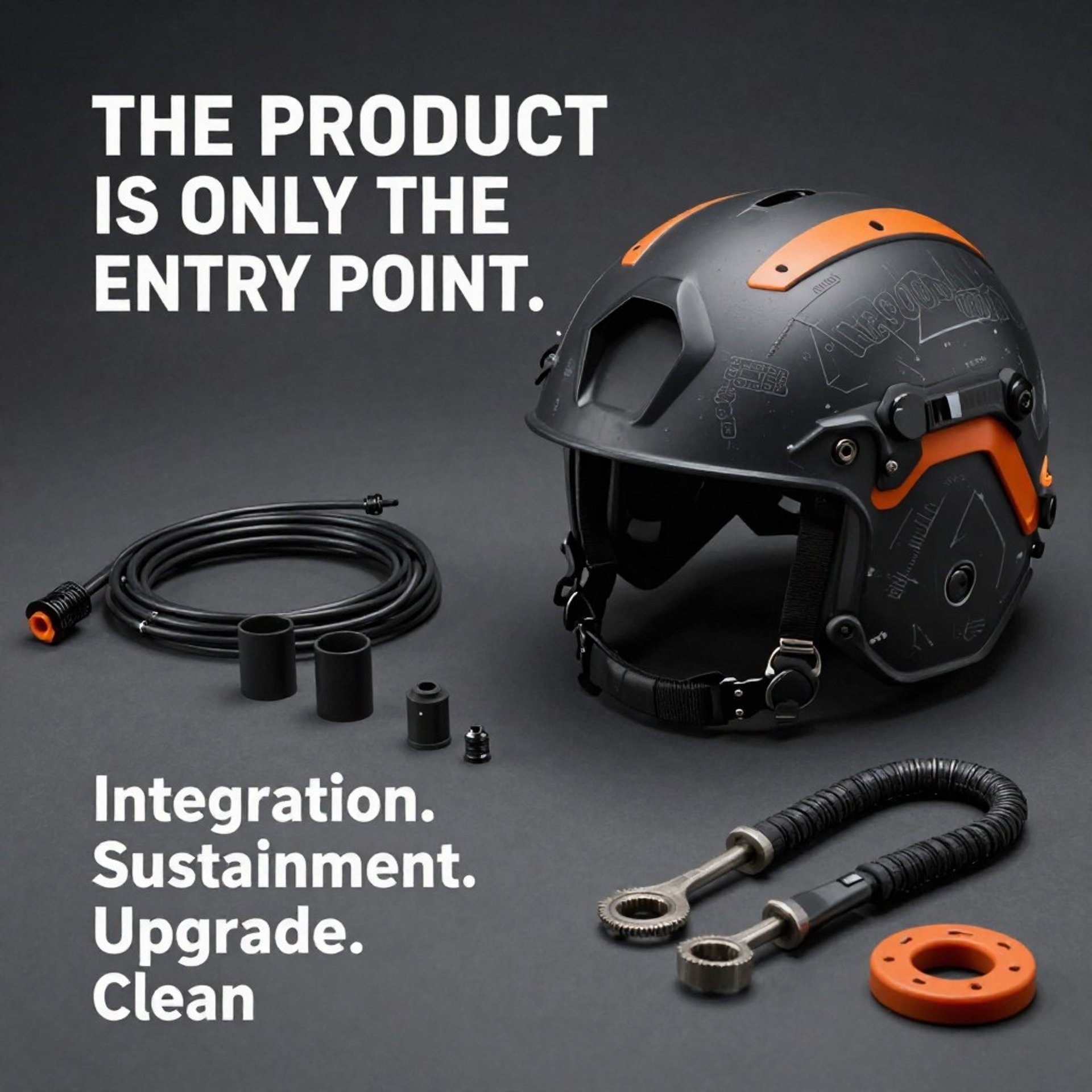
Those claims remain important, but they increasingly describe only the entry point.
The buyer must also understand how the equipment will integrate into an existing system, how it will be supported, how components will be replaced, how upgrades will be controlled and how operational availability will be maintained.
That changes the commercial proposition.
A helmet is no longer only a protective shell.
It can be the platform for communications, hearing protection, eye protection, respiratory interfaces, identification systems and future upgrades.
A gas detector is no longer only an individual instrument.
It may sit inside a wider system connecting worker protection, fixed detection, alarms, control infrastructure, maintenance and operational data.
The commercial value moves from product ownership toward system ownership.
Commercial Implication
This creates a problem for manufacturers whose products are credible but whose proposition remains catalogue-led.
They may have the necessary services, parts, training and technical support.
But these are often buried after the product specification rather than built into the reason to buy.
That weakens the proposition because buyers in specialist markets are not only evaluating performance.
They are evaluating risk.
Integration risk.
Deployment risk.
Maintenance risk.
Configuration risk.
Supply risk.
Training risk.
Lifecycle risk.
The manufacturer that makes those risks easier to understand and control has a commercial advantage before any tender score is awarded.
Lifecycle support must become visible earlier
Servicing and sustainment are often treated as post-sale functions.
Commercially, they belong much earlier.
They should influence:
Product architecture
Portfolio structure
Tender strategy
Channel selection
Training models
Pricing
Customer messaging
Account development
Upgrade planning
When lifecycle support is separated from positioning, the manufacturer leaves value on the table.
It also makes it easier for the buyer to compare the product on unit price rather than total operational value.
The stronger proposition
A specialist manufacturer should be able to explain:
How the product integrates into the customer’s existing environment.
How capability will be maintained after deployment.
How parts, inspections and repairs will be managed.
How upgrades will be introduced without disrupting operations.
How responsibility is divided between manufacturer, distributor and user.
How the system reduces risk across its full service life.
This is not supporting detail.
It is the commercial case.
Credible equipment opens the door.
Integration, sustainment and lifecycle ownership determine whether the manufacturer builds lasting traction once it gets inside.
© 2026. All rights reserved.
hello@kernstrategicadvisory.com